
Emotional turmoil can leave a lasting imprint on both the mind and body. Experiences such as grief, relationship breakdowns, chronic stress, burnout, or sudden life changes often overwhelm the nervous system and disrupt internal balance. Even when emotions are no longer at the surface, their effects can remain, showing up as tension, fatigue, anxiety, poor sleep, or a sense of disconnection from oneself. Recovery from emotional upheaval is rarely instantaneous; it requires gentle support that allows the system to settle and reorganise.
Reiki offers a supportive pathway for restoring balance after emotional turmoil by working with the body’s natural capacity for regulation and healing. Rather than analysing or reliving difficult experiences, Reiki creates a calm, supportive environment in which emotional stress can soften and release at its own pace. This blog explores how emotional turmoil affects the system, how Reiki supports recovery, and why this gentle approach can be so effective in restoring emotional and energetic balance.
Understanding Emotional Turmoil and Its Effects
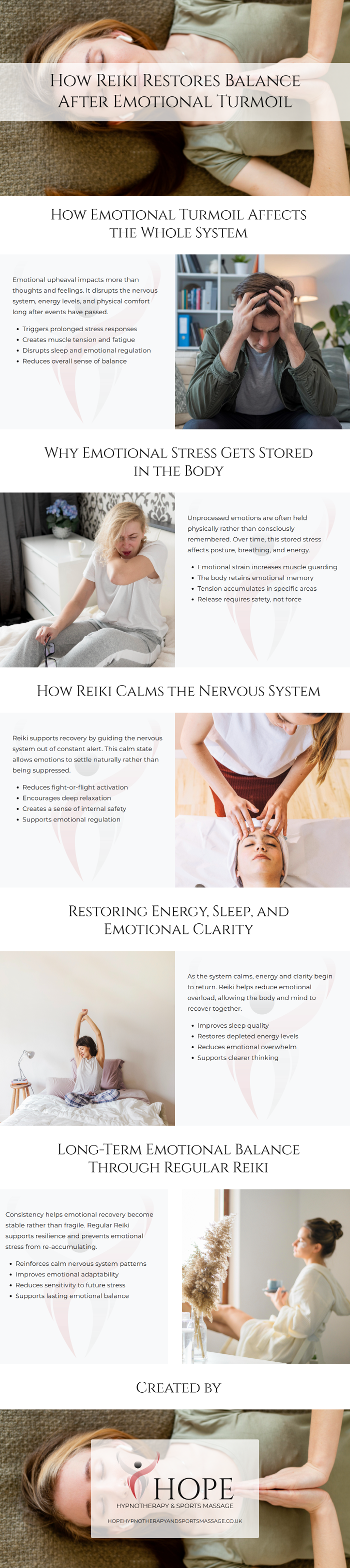
Emotional turmoil occurs when experiences overwhelm the body’s capacity to process and regulate emotion. This state is not limited to the mind; it affects the nervous system, muscles, breathing patterns, and overall energy levels. Reiki helps support recovery by addressing these system-wide effects.
- Emotional overload disrupts nervous system regulation
- Stress responses remain active long after events pass
- Physical tension often reflects emotional strain
- Balance requires whole-system calming
How Emotions Are Held in the Body
Emotions are not experienced only as thoughts. They are felt physically through changes in muscle tone, posture, breathing, and internal sensation. When emotions are suppressed or unresolved, they can become stored as chronic tension or fatigue. Reiki supports gentle release without force.
- Emotional stress increases muscle guarding
- Unprocessed feelings contribute to physical tightness
- The body remembers emotional experiences
- Gentle support allows release without overwhelm
The Nervous System After Emotional Stress
Emotional upheaval often leaves the nervous system stuck in a heightened state of alert. Even when external stressors have passed, the body may continue to respond as though threat is present. Reiki helps guide the nervous system back toward calm and safety.
- Emotional stress activates fight-or-flight responses
- Ongoing alertness prevents rest and recovery
- Calm states support emotional processing
- Regulation restores internal balance
Why Emotional Recovery Takes Time
Healing after emotional turmoil is not linear. The system needs time and safety to reorganise itself. Reiki respects this process by offering consistent, non-invasive support rather than pushing for rapid change.
- Emotional healing unfolds gradually
- Forcing release can increase resistance
- Safety is essential for recovery
- Consistency supports long-term balance
How Reiki Creates a Sense of Safety
Emotional balance cannot be restored without a felt sense of safety. Reiki helps create this by calming the body and nervous system, allowing emotions to settle naturally rather than being suppressed or intensified.
- Calms physiological stress responses
- Encourages deep relaxation
- Reduces internal threat perception
- Supports emotional grounding
Reducing Emotional Overload Through Relaxation
Emotional turmoil often keeps the mind and body in a state of constant activation. Reiki promotes deep relaxation, which reduces emotional overload and allows the system to reset.
- Lowers mental and emotional intensity
- Reduces constant internal pressure
- Encourages emotional breathing space
- Supports restorative rest
Reiki and Emotional Regulation
Emotional regulation is the ability to experience feelings without becoming overwhelmed by them. Reiki supports this skill by calming the nervous system and improving awareness of emotional states without judgement.
- Supports balanced emotional responses
- Reduces emotional reactivity
- Encourages steadier mood patterns
- Improves emotional resilience
Supporting Grief and Loss
Grief is a deeply personal process that affects both emotional and physical wellbeing. Reiki offers gentle support during grief by providing calm presence rather than attempting to fix or rush the process.
- Supports the body during emotional exhaustion
- Encourages rest during grief
- Reduces tension linked to emotional holding
- Allows space for emotional expression
Releasing Emotional Tension Stored in the Body
Emotional tension often settles into specific areas such as the chest, shoulders, jaw, or abdomen. Reiki supports release by encouraging relaxation and awareness without forceful intervention.
- Reduces chronic tension patterns
- Improves awareness of emotional holding areas
- Encourages gentle physical softening
- Supports emotional comfort
Improving Sleep After Emotional Stress
Sleep is often disrupted after emotional upheaval due to ongoing nervous system activation. Reiki supports better sleep by calming mental activity and reducing physical tension.
- Supports easier transition into sleep
- Reduces night-time emotional rumination
- Encourages deeper rest
- Improves recovery through sleep quality
Restoring Energy After Emotional Drain
Emotional turmoil can significantly drain energy levels. Reiki helps restore vitality by reducing stress-related energy depletion and supporting balanced energy flow throughout the body.
- Reduces fatigue linked to emotional stress
- Supports energy conservation
- Encourages sustainable vitality
- Improves overall sense of balance
Reconnecting with the Body After Emotional Shock
After intense emotional experiences, many people feel disconnected from their bodies. Reiki supports gentle reconnection, helping individuals feel more present and grounded.
- Encourages body awareness
- Supports grounding after emotional shock
- Reduces dissociation
- Improves sense of stability
Supporting Emotional Clarity
Emotional turmoil often clouds perspective and decision-making. As the system calms, clarity naturally improves. Reiki supports this process by reducing internal noise and emotional overwhelm.
- Reduces mental confusion
- Encourages emotional perspective
- Supports clearer thinking
- Improves decision-making confidence
Reiki as a Non-Verbal Supportive Therapy
Some emotional experiences are difficult to articulate. Reiki offers support without requiring verbal processing, making it accessible during times when talking feels overwhelming.
- Supports healing without verbal effort
- Reduces pressure to explain emotions
- Encourages internal processing
- Respects personal boundaries
Integrating Emotional Experiences Gently
Integration involves allowing emotional experiences to settle into memory without ongoing distress. Reiki supports this process by creating internal calm and stability.
- Encourages emotional settling
- Reduces lingering stress responses
- Supports acceptance and integration
- Promotes emotional ease
The Importance of Regular Reiki During Recovery
Consistency plays a key role in emotional recovery. Regular Reiki sessions help reinforce calm nervous system patterns and prevent emotional stress from reaccumulating.
- Reinforces emotional regulation
- Supports steady recovery progress
- Prevents overwhelm from returning
- Encourages long-term balance
Long-Term Emotional Balance Through Reiki
Over time, Reiki supports emotional balance by strengthening the body’s ability to regulate stress and respond adaptively to challenges. This resilience helps prevent future emotional overwhelm.
- Improves emotional adaptability
- Reduces sensitivity to stress
- Encourages internal stability
- Supports ongoing emotional wellbeing
Conclusion
Emotional turmoil affects far more than thoughts and feelings; it impacts the entire system, from nervous regulation to physical comfort and energy levels. Restoring balance after emotional upheaval requires approaches that respect the body’s need for safety, gentleness, and time. Reiki supports this process by calming stress responses, reducing emotional overload, and creating an internal environment where healing can unfold naturally.
Rather than forcing emotional release or intellectual understanding, Reiki allows balance to return through relaxation, presence, and regulation. Over time, this gentle support helps individuals feel more grounded, resilient, and emotionally steady. By restoring balance after emotional turmoil, Reiki offers a compassionate pathway back to stability, clarity, and a renewed sense of inner calm.

5 star reviews

Proven results

Holistic healing



REVIEWS
What clients have to say
Hypnotherapy has totally changed my outlook on life and changed me to thinking much more positive. Ian was very professional and his treatment room is a lovely relaxing space. I can’t thank Ian enough for everything.
From the beginning of the therapy my sleep improved and gradually over the sessions my symptoms reduced. By the end of my course of therapy I felt much stronger and empowered to deal with daily life.
Ian very quickly addressed issues I was having with just a conversation this is due to his extensive knowledge within the industry. This allowed him to get straight to work on each muscle group to relieve my pain and symptoms.
Everything was easy to understand, and he gave me certain activities to complete, through the day, and prior to going to bed in the evening, and the results are amazing. I am sleeping a lot better, find it easier to fall asleep, but the main thing for me was waking up less through the night.
If you struggle with food noise or feel like food thoughts dominate your day, I would definitely recommend giving hypnotherapy with Ian a try. It’s been a surprisingly empowering experience.
I believe hypnotherapy has helped me to reverse a lot of and allowed my thought patterns to become more positive. This has given me the belief that I will get better.
I saw Ian for four hypnotherapy sessions to help with my long-standing fear of flying, and the results were amazing. He created a calm, supportive environment and guided me through techniques that helped shift my mindset.
After a few weeks I felt more positive, relaxed and was sleeping better. I still have some work to do but I feel Ian has provided me with the tools to make positive changes moving forward.
The way Ian explained the root cause and how hypnotherapy could help made sense and I bought into this from day one. I started to feel improvement after my first session and after 3 sessions the difference was massive.