
Stress is one of the most common experiences of modern life. While some stress can be motivating, chronic or unmanaged stress can take a toll on both physical and mental health. It affects sleep, mood, relationships, and even our ability to make good decisions. But what many people don’t realise is that much of how we respond to stress happens below the level of conscious thought.
The subconscious mind—the part of our mind that runs automatic behaviours, emotions, and physiological responses—plays a powerful role in how we perceive and respond to challenges. Understanding this connection is the first step to taking back control. When we work with the subconscious mind rather than against it, we can reduce unnecessary stress, retrain unhelpful patterns, and create healthier responses.
In this article, we’ll explore the relationship between stress and the subconscious mind, the science behind automatic stress reactions, and practical ways to reprogram these responses for better wellbeing.
Understanding the Subconscious Mind
The mind is often divided into two parts: the conscious and the subconscious. The conscious mind handles logical thinking, decision-making, and reasoning. It is the part we are most aware of. The subconscious mind, on the other hand, operates in the background. It stores memories, habits, emotions, and beliefs—and controls automatic processes like breathing, heart rate, and reflexes.
The subconscious mind acts as a filter, processing vast amounts of information and influencing how we respond to situations, often before we are consciously aware of them. This is why we sometimes react emotionally or physically to a situation before we’ve had time to “think” about it.
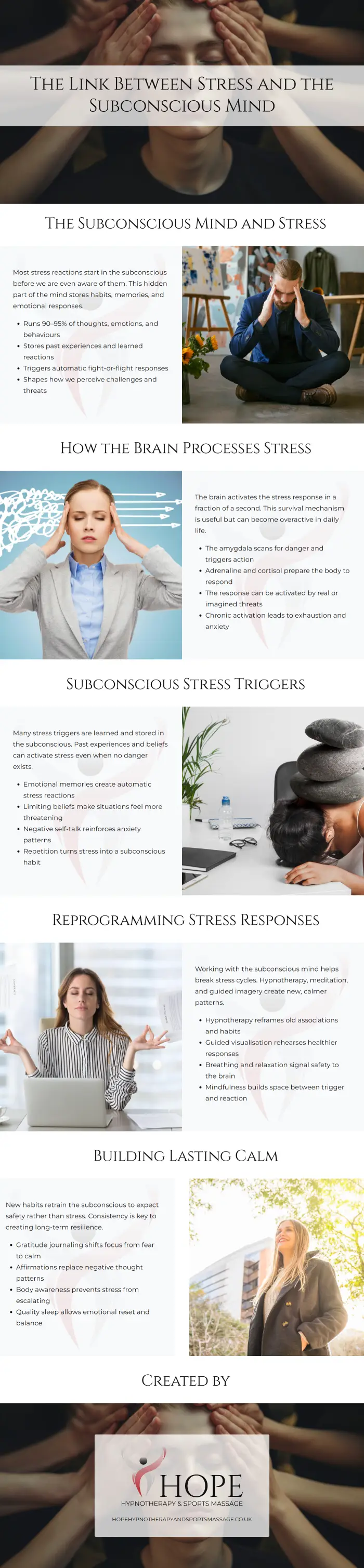
- The subconscious mind runs 90–95% of our thoughts and behaviours
- It stores emotional memory and past experiences
- Influences automatic reactions such as fear, stress, and excitement
- Shapes how we perceive and respond to new situations
How Stress Is Processed in the Brain
When we face a stressful situation, the brain activates a network known as the stress response system. The amygdala, part of the limbic system, plays a key role by rapidly scanning for danger. If it perceives a threat, it signals the hypothalamus to activate the “fight-or-flight” response, releasing adrenaline and cortisol.
This process happens in a fraction of a second—much faster than conscious thought. It is a survival mechanism designed to protect us from harm. The problem is that the brain does not always distinguish between real, immediate threats and perceived threats such as a work deadline or a difficult conversation.
- The amygdala triggers the stress response before conscious thought
- Adrenaline and cortisol prepare the body for action
- The response is useful for short-term survival but harmful if chronic
- The subconscious can overreact, triggering stress unnecessarily
The Subconscious Roots of Stress Triggers
Many stress triggers are not purely rational. They are learned responses stored in the subconscious mind, often based on past experiences. For example, someone who was criticised harshly as a child may feel anxious in situations where they risk judgment, even if there is no real threat.
These patterns become “programmed” in the subconscious and can be triggered automatically by certain cues—tone of voice, body language, or even specific places. Over time, this creates a cycle of stress that feels difficult to control consciously.
- Stress responses can be linked to past experiences and emotional memory
- The subconscious creates associations between events and emotions
- Automatic triggers can activate stress without a conscious reason
- Recognising these patterns is the first step to changing them
The Role of Beliefs and Self-Talk
Beliefs held in the subconscious mind shape how we interpret the world. If we hold beliefs such as “I’m not good enough” or “I have to be perfect,” our stress response is more likely to activate when those beliefs feel threatened.
Negative self-talk can also reinforce stress. The subconscious mind responds to repeated thoughts as if they are true, meaning a cycle of worry can keep the stress response switched on.
- Limiting beliefs create a heightened sense of threat
- Negative self-talk amplifies anxiety and stress reactions
- The subconscious treats repeated thoughts as reality
- Reframing beliefs can reduce unnecessary stress triggers
How Stress Becomes Habitual
Over time, repeated stress responses create “pathways” in the brain, making the reaction more automatic. The subconscious learns that certain situations are threatening, even when they are not, and activates the stress response pre-emptively.
This can result in chronic stress, where the body remains in a state of tension even in the absence of a clear trigger. Breaking this cycle requires retraining the subconscious to respond differently, which is where therapeutic techniques can be so helpful.
- Repeated stress responses strengthen neural pathways in the brain
- Stress becomes a “habit” that the subconscious repeats automatically
- Chronic stress leaves the body in a constant state of alertness
- Retraining these patterns restores balance and calm
Working With the Subconscious to Reduce Stress
The good news is that the subconscious mind can be reprogrammed. By using techniques that bypass the critical conscious mind—such as hypnotherapy, meditation, or guided visualisation—we can introduce new, healthier patterns of thought and response.
Hypnotherapy, for example, helps access the subconscious state and replace unhelpful associations with positive suggestions. This can reduce the intensity of stress triggers and create calmer automatic responses.
- Hypnotherapy reframes subconscious associations that fuel stress
- Guided imagery can “rehearse” new, calmer reactions
- Meditation trains the mind to pause before reacting
- Breathing exercises signal safety to the subconscious
The Role of Body Awareness
Because the subconscious mind controls physiological responses, tuning into the body is key for stress management. Practices like yoga, progressive muscle relaxation, and mindfulness teach us to notice early signs of stress—tight shoulders, shallow breathing, racing thoughts—before they escalate.
By catching these signs early, we can intervene with calming techniques and prevent the stress cycle from taking over. This builds a sense of safety that gradually retrains the subconscious mind.
- Body awareness helps identify stress before it peaks
- Mindfulness builds space between trigger and reaction
- Gentle movement and stretching reduce stored tension
- Regular practice teaches the subconscious to feel safe again
The Connection Between Sleep, Stress, and the Subconscious
Sleep is a vital time for the subconscious mind to process experiences and regulate emotions. When we are chronically stressed, sleep often becomes disrupted, which then makes the stress response more sensitive the following day.
Supporting healthy sleep through relaxation techniques, bedtime routines, and reducing stimulants helps the subconscious integrate memories and reset emotional balance.
- The subconscious processes emotional memories during sleep
- Poor sleep keeps stress hormones elevated
- Relaxation techniques before bed calm the nervous system
- Good sleep hygiene strengthens resilience to stress
Reprogramming Stress Through Positive Habits
Creating new, supportive habits trains the subconscious mind to expect calm rather than stress. Repetition is key—just as old stress patterns were formed through repetition, new patterns must be reinforced consistently.
Daily rituals such as gratitude journaling, affirmations, and mindful breathing gradually shift the baseline of the nervous system, making it easier to remain calm under pressure.
- Repetition builds new neural pathways for calm responses
- Gratitude practices shift focus from threat to safety
- Positive affirmations replace negative self-talk
- Consistent practice rewires the subconscious over time
Conclusion: A New Relationship With Stress
The link between stress and the subconscious mind explains why stress can feel so overwhelming—and why logic alone is often not enough to calm it. Our reactions are shaped by past experiences, beliefs, and automatic patterns stored deep below conscious awareness.
By working with the subconscious through hypnotherapy, meditation, body awareness, and positive habit formation, we can change those patterns. Stress may always be part of life, but it no longer has to dominate it.
When the subconscious mind learns that it is safe, the body relaxes, the mind clears, and challenges can be faced with confidence rather than fear. This is the key to not just managing stress but transforming it into a source of growth and resilience.

5 star reviews

Proven results

Holistic healing



REVIEWS
What clients have to say
From the beginning of the therapy my sleep improved and gradually over the sessions my symptoms reduced. By the end of my course of therapy I felt much stronger and empowered to deal with daily life.
Ian very quickly addressed issues I was having with just a conversation this is due to his extensive knowledge within the industry. This allowed him to get straight to work on each muscle group to relieve my pain and symptoms.
If you struggle with food noise or feel like food thoughts dominate your day, I would definitely recommend giving hypnotherapy with Ian a try. It’s been a surprisingly empowering experience.
Everything was easy to understand, and he gave me certain activities to complete, through the day, and prior to going to bed in the evening, and the results are amazing. I am sleeping a lot better, find it easier to fall asleep, but the main thing for me was waking up less through the night.
Hypnotherapy has totally changed my outlook on life and changed me to thinking much more positive. Ian was very professional and his treatment room is a lovely relaxing space. I can’t thank Ian enough for everything.
After a few weeks I felt more positive, relaxed and was sleeping better. I still have some work to do but I feel Ian has provided me with the tools to make positive changes moving forward.
The way Ian explained the root cause and how hypnotherapy could help made sense and I bought into this from day one. I started to feel improvement after my first session and after 3 sessions the difference was massive.
I saw Ian for four hypnotherapy sessions to help with my long-standing fear of flying, and the results were amazing. He created a calm, supportive environment and guided me through techniques that helped shift my mindset.
I believe hypnotherapy has helped me to reverse a lot of and allowed my thought patterns to become more positive. This has given me the belief that I will get better.